

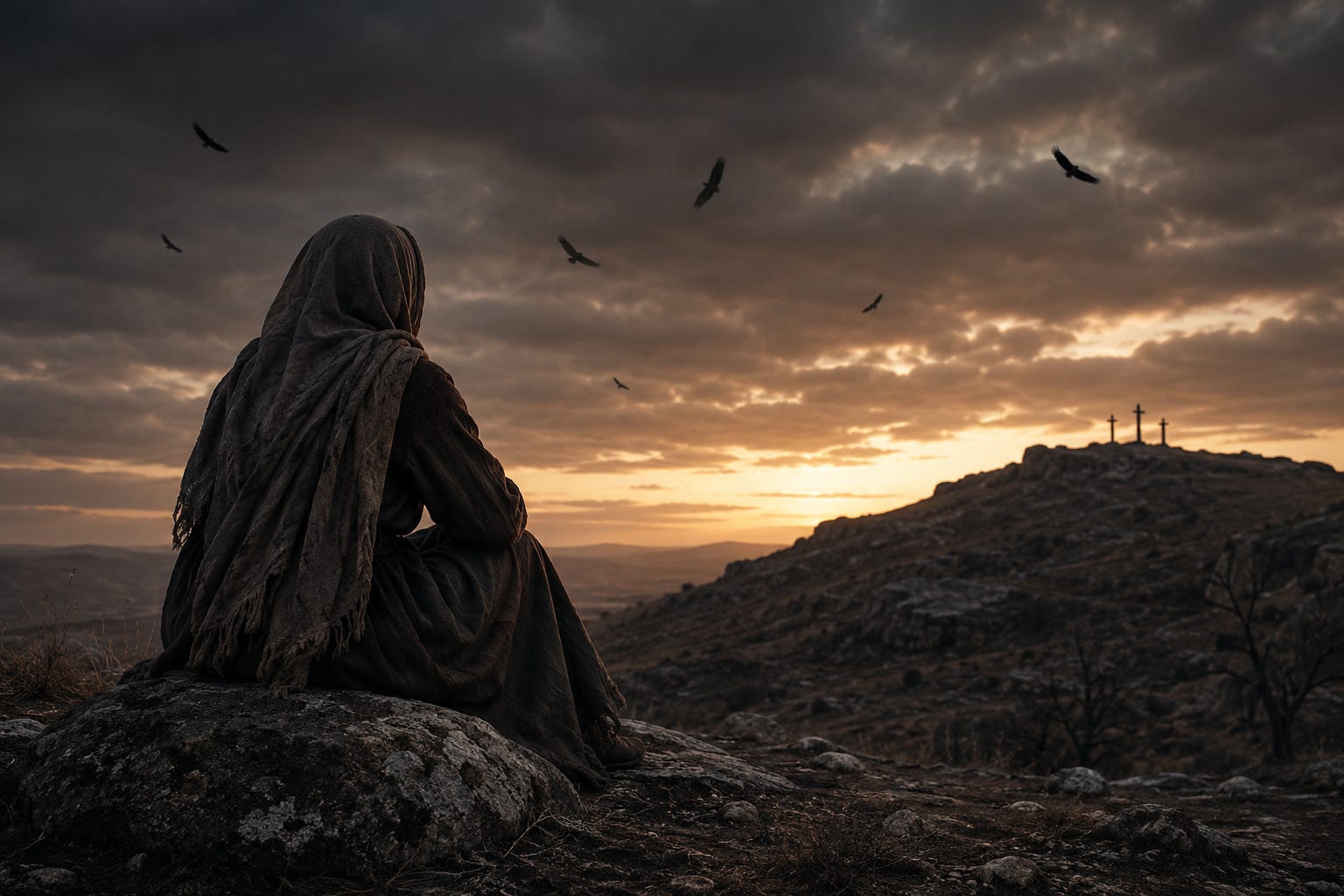
Their bodies were left on a mountain, but shame did not get the final word.
Rotting.
Exposed.
Shamed.
Hung from a tree.
Seven sons from the house of Saul. To the watching world, the storyline seemed clear.
Evil lived here. Justice had come. A bloody house had finally been exposed.
But for the modern-day reader like you and me, shock and empathy may be the only honest response, despite the context of true justice.
And then comes a glimmer of hope.
A woman. A mom. Rizpah.
A woman the world may have overlooked as weak, insignificant, and powerless.
But in the kingdom of God, she stands as a warrior.
An image bearer.
In the middle of the night, she fought off the birds.
In the daytime, she fought off the beasts.
And she waited.
And waited.
And waited.
Never sheathing her weapon.
Her heart was not longing for revenge. Her grief was not pretending the tragedy was good. She simply refused to let shame have the final word.
Rizpah could not give them life back.
But she could preserve their dignity.
She could not sit on a throne.
But she could sit on a rock.
She could not issue decrees.
But her grief became a witness.
Their bodies matter.
Their names matter.
Their story does not end as forgotten waste on a mountain.
I do not know what season you are in, but that image has been a powerful message for me.
And maybe it is for you too.
Rizpah honored the dead under the weight of justice and grief. She sat honestly in the sorrow.
She did not erase the tragedy.
She did not pretend evil was good.
She did not rewrite the story.
But she refused to let exposure become the final sentence.
And when David heard what she had done, something moved in him.
He gathered the bones of Saul and Jonathan, along with the bones of the seven men, and gave them an honorable burial. A hard story received a kind of closure.
And the overlooked woman became the moral center of a powerful scene.
That matters.
In that world, men usually held the positions of public power. Women were often overlooked, dismissed, or treated as weaker by society.
But Scripture does not say women matter because they are useful to men.
Scripture does not say women matter only because they are mothers, wives, sisters, or daughters.
Women matter because God made them in His image.
“So God created man in His own image, in the image of God He created him, male and female He created them.”
Genesis 1:27
That is the foundation.
Not usefulness.
Not status.
Not public platform.
Image.
God’s image.
So when 1 Corinthians 1:27–29 says God chose what is weak in the world to shame the strong, we need to hear it rightly.
It does not mean women are inherently weak.
It means God often chooses those the world calls weak to expose the emptiness of worldly strength.
Widows.
Foreigners.
Barren mothers.
Children.
Shepherd boys.
Exiles.
Slaves.
Fishermen.
And ultimately, a crucified Messiah.
The world looked at the cross and saw weakness. God revealed salvation.
The world looked at Jesus and saw defeat. God revealed glory.
The world looked at His exposed body and saw shame. God revealed grace.
And this is where Rizpah points us forward.
Rizpah sat near the exposed dead and guarded them in love.
At the cross, women stayed near the exposed Son of David when many of the disciples scattered.
Mary Magdalene and other women remained close to Jesus in His death, His burial, and His resurrection.
Then God entrusted women with the first announcement of the risen Christ.
That is not random.
The world often said, “These witnesses do not count.” God said, “They saw Him first.”
Rizpah could not raise the dead. But Jesus can.
Rizpah could guard dignity. Jesus conquers shame.
Rizpah could testify that the body matters. Jesus rose bodily from the grave.
Rizpah waited under grief. Jesus entered death and walked out alive.
That is the gospel.
Not that shame never touches us. Not that discipline never comes. Not that grief disappears if we believe hard enough.
The gospel is that Jesus Christ, crucified and risen, is Lord over sin, shame, death, accusation, exposure, and the grave.
We are saved by grace alone, through faith alone, in Christ alone.
Shame does not get lordship over your identity.
Jesus does.
Never Finished Challenge
Rizpah refused to let shame have the final word over bodies everyone else seemed willing to leave exposed.
I do not know what is tempting you to let shame have the final word.
One incident.
One accusation.
One public misunderstanding.
One season of waiting.
One place of exposure.
One moment you wish you could undo.
One chapter where people think they know the whole story.
Do not let that write the final sentence over what God is doing.
Rizpah did not erase the tragedy.
She did not pretend the sons were alive.
She did not call evil good.
She did not rewrite the story.
She sat in the grief honestly.
But she refused to let their bodies be treated like forgotten waste.
The gospel does not tell you to pretend the incident did not happen.
It tells you shame does not get the throne.
There is a flesh response.
And there is a gospel response.
The flesh says, “That never mattered.”
The gospel says, “That happened, and Jesus is greater.”
The flesh says, “I have to prove myself now.”
The gospel says, “I walk in repentance, wisdom, and sonship.”
The flesh says, “I am disqualified forever.”
The gospel says, “God disciplines sons and does not abandon them.”
The flesh says, “I need everyone to understand me.”
The gospel says, “I need to be faithful before God.”
The flesh says, “Shame defines me.”
The gospel says, “Christ defines me.”
So do not force open what God has not opened yet.
Do not build from panic.
And, like I often do, do not outrun the Spirit.
Remain faithful while God closes what only He can close.
Take the next faithful step.
And in my season of waiting, that faithful step has been simple.
Open the Word.
Stay before God.
Ask Him again, “What will today say about You?”
Do not let shame have the final word.
Let Jesus have the deepest word.
Shame is not your king. Accusation is not your shepherd. Exposure is not your grave. Discipline is not abandonment.
Your story is not finished at the place of exposure.
Your story is not finished at the place of accusation.
Your story is not finished at the place where people misunderstand you.
Your story is not finished on the mountain.
The final word belongs to the crucified and risen King.
So stand up.
Open the Word.
Walk in repentance.
Stay faithful.
The King is still writing.
Fill your cup daily.
Have Jesus for Breakfast.